I-751 RFE for bona fide marriage: what to send back
A request for evidence is not a denial. An officer has already read the file and named the gap, and the notice carries a deadline. Answer that gap with the categories USCIS prints in the Form I-751 instructions, then add third-party letters that match the affidavit paragraph word for word.
What the RFE is actually asking
Conditional residence is granted for two years. To keep it, the conditional resident files Form I-751 during the 90-day period immediately before the card expires (Form I-751 instructions, edition 04/01/24). When the filing does not convince the officer that the marriage was real, USCIS sends a request for evidence instead of deciding.
The instructions state the standard in one sentence: submit documents showing the marriage “was entered in ‘good faith’ and was not for the purpose of circumventing immigration laws,” covering the circumstances from the date of the marriage to the present and, if the relationship has ended, the circumstances around the end. Read the RFE against that sentence. Most notices are not asking for a character reference. They are asking for proof that the two of you shared a life: money, housing, children, travel, insurance, mail.
That matters for how you spend the response window. A folder of warm letters cannot replace a joint tax return. Letters are the fifth item on the USCIS list, and the instructions attach a condition to them: they must be supported by the other evidence.
The five evidence categories USCIS prints
The Form I-751 instructions list the following examples of relationship evidence. They are examples, not a checklist that every case must satisfy, but an officer reading an RFE usually has one or two of these in mind.
- Children. Birth certificates of children born during the marriage.
- Housing. Lease or mortgage contracts showing joint occupancy or joint ownership of the home.
- Money. Joint savings or checking accounts with transaction history, complete joint federal and state tax returns, insurance policies naming the spouse as beneficiary, joint utility bills, joint installment loans or other joint debt.
- Anything else relevant. The instructions leave this open: documents that show the marriage was not entered to evade immigration law.
- Affidavits. Sworn or affirmed statements from at least two people who have known both of you since conditional residence was granted and who have personal knowledge of the marriage.
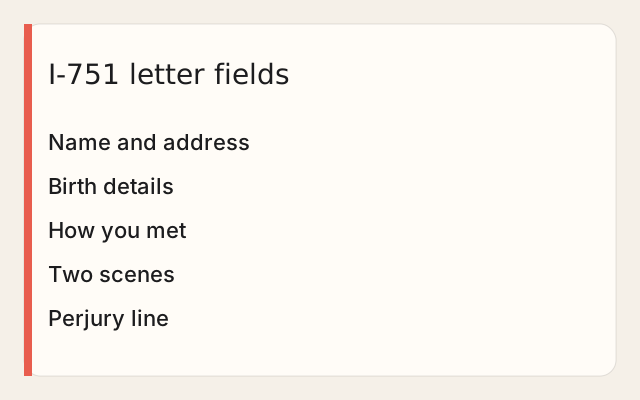
The affidavit paragraph is specific about what each statement must contain: the writer's full name and address, date and place of birth, relationship to you or your spouse, and full information plus complete details explaining how the person acquired that knowledge. The original affidavit has to be submitted. The same paragraph ends with the sentence that decides most RFE responses: “Affidavits must be supported by other types of evidence listed above.”
In plain terms: letters explain the marriage. They do not prove it on their own. Build the response so the primary documents carry the case and the letters translate those documents into a story an officer can follow.
What a support letter needs to survive the RFE
A letter written for an RFE is not a character reference and not a greeting card. It is a witness statement. The strongest version answers the four questions an officer is silently asking.
Who is this person, and how do they know you?
Full legal name, address, date and place of birth, and the exact relationship: sister, neighbor, coworker, college friend. Then the part people skip: how often they saw you as a couple, in which period, and in what setting.
What did they personally see?
Two scenes, dated and located. The dinner after the move, the holiday at the parents' house, the Sunday market, the hospital visit. A scene has a place, a rough date, other people present, and one detail that could not be copied from another couple's letter.
What can they say that a stranger could not?
The detail is the proof. “They seem happy together” is filler. “I helped them carry a couch into the apartment on 14 March and stayed for dinner with both of them” is evidence of a shared home.
Is the letter honest and signed?
The writer signs and dates it, includes contact details, and strikes anything they did not personally witness. An affidavit that overstates what the writer saw is worse than a shorter one. USCIS can ask a writer to testify about the statement.
That is the job I751 Letters automates: the couple enters the marriage facts and each writer's scenes once, the site drafts one letter per writer, and each writer opens a private link to correct or delete anything that is not true before signing. The preview is free, and the packet is paid once, after you have read a partial draft.
Four ways to get the letters, compared
These options solve different jobs. Two of them prepare the petition itself; two give you the third-party letters. Prices below were read from each provider's public page on 21 October 2026.
| Option | What you get | Published price | What it does not do |
|---|---|---|---|
| Blank template from a search result | A skeleton letter you rewrite from scratch for every writer. | $0 | No per-writer review, no guard against leftover names, cities or dates from another couple. |
| I751 Letters | One drafted letter per writer from the facts you enter, a private edit link per writer, and an optional short petitioner cover letter in the Filing and Family packets. | $19 Standard (up to 4 writers), $29 Filing (up to 4 writers and a cover letter), $49 Family (up to 6 writers and a cover letter) | It does not prepare Form I-751, does not collect your primary evidence, and does not give legal advice. |
| CitizenPath | The Removal of Conditions Petition Package: Form I-751, Form G-1145, personalized instructions with a supporting-document checklist, and live support. | $139 plus USCIS fees | It prepares the petition. It cannot write a friend's firsthand account for them. |
| Boundless | Guided removal-of-conditions preparation with forms completed for you; attorney consultations are sold separately. | $449 for the service; Ask My Attorney consultations listed at $79 per 30 minutes | It prepares the filing. The firsthand statements still have to come from your writers. |
The government fee is separate from every option above. USCIS Form G-1055 lists the I-751 filing fee at $750 for a paper filing and $700 for an online filing (checked 21 October 2026). A waiver exists only in specific cases, such as a joint-filing waiver based on battery or extreme cruelty.
A response packet that reads like a file
Officers process volumes. Make the response easy to navigate and hard to misread.
- Cover sheet first. Receipt number, the date of the RFE, the petitioner's name, and a short exhibit list in the order the notice asks for evidence.
- Answer in the same order as the RFE. If the notice lists three gaps, use three headings. Do not make the officer hunt.
- Primary evidence before letters. Joint tax returns, lease or mortgage, account statements with transaction history, insurance, children's birth certificates. Label exhibits A, B, C and keep the labels consistent.
- Letters as their own exhibit. Each one signed, dated, with the writer's address and contact details. Originals, as the instructions ask.
- One sentence per exhibit. “Exhibit C: joint checking account statements, January to December, showing shared household expenses.” The sentence tells the officer what the document proves.
- Copy everything before you send it. Keep the complete packet, including the signed letters, in one folder.
Mistakes that turn an RFE into a denial
- Missing the deadline on the notice. The Form I-751 instructions warn that failure to provide requested information and evidence “may delay a final decision or result in denial of your benefit request.”
- Resending the same stack. If the officer asked for joint finances, another pile of wedding photos does not answer the question.
- Copied templates. Leftover names, a city the writer never lived in, or a scene that belongs to another couple destroys the letter's value.
- Letters with no dates, addresses or signatures. The affidavit paragraph asks for all of them, and an unsigned statement is not an affidavit.
- Letters that describe the wedding only. The instructions ask about the marriage from the grant of conditional status to the present. The daily life is the point.
- Letters without primary evidence. The instructions say affidavits must be supported by the other evidence. A response built only on letters invites another request.
- Pressure on a writer. Do not ask anyone to sign something they did not see. A witness who recants is far worse than a missing letter.
Questions people ask when the RFE arrives
The answers below restate public USCIS material and the limits of this drafting tool. They are not advice about your case.
Questions
Does an I-751 RFE mean the case is denied?
No. A request for evidence asks for more information before a decision. A denial is a separate decision with its own notice and its own options. Treat the RFE as a deadline, not a verdict.
How long do I have to respond to an I-751 RFE?
The deadline is printed on the notice itself. USCIS instructions warn that failing to provide the requested information and evidence may delay a final decision or result in denial, so plan to send the response before that date rather than on it.
How many affidavits should an I-751 RFE response include?
The Form I-751 instructions ask for sworn or affirmed statements from at least two people who have known both of you since conditional residence was granted. Two strong, specific letters answer the paragraph. More letters do not replace missing joint financial or housing evidence.
What must each affidavit contain?
The writer's full name and address, date and place of birth, relationship to you or your spouse, and complete details of how they acquired their knowledge. The original signed statement is submitted, and the instructions say affidavits must be supported by other types of evidence.
Do I-751 affidavits need to be notarized?
The form instructions ask for sworn or affirmed statements with the writer's signature and details; they do not require a notary. Some attorneys still prefer a notary page. Follow the wording in your RFE notice if it asks for something specific.
Can we answer the RFE with letters only?
No. The instructions are explicit that affidavits must be supported by the other evidence listed above them, such as joint tax returns, a lease or mortgage, and joint financial records. Letters explain the documents; they do not replace them.
Can a relative or a coworker write the letter?
Yes, if the person has known both of you since conditional residence was granted and has personal knowledge of the marriage. A relative who hosted you, a neighbor who saw the daily routine, or a coworker who met your spouse repeatedly is a stronger writer than someone who met you once.
Does this page also fit an I-130 RFE?
The same third-party relationship letter is used in spouse-petition filings. Change the form name in the heading and keep the scenes true. The I-130 affidavit sample page shows the version for a spouse petition.
Is this legal advice?
No. I751 Letters drafts third-party relationship letters from facts you provide. It is not a law firm, it does not prepare Form I-751 or Form I-864, and it does not promise a USCIS decision.